
It begins as a fleeting moment. A slight sway while standing up, a brief blur in vision, or that odd feeling of almost fainting. Many brush it off. But doctors across India say these small episodes are showing up far more often in clinics today.“Lightheadedness is among the most frequently reported symptoms but at the same time the most ignored one in clinical practice today,” says Dr Niranjan Singh, Senior Consultant, Internal Medicine. “People often overlook mild dizziness, thinking it is momentary or not serious, whereas it might just be a warning sign of the body.”So what is changing? And why now?
The heat is not just uncomfortable, it is overwhelming the body
Summer is not what it used to be. Longer heatwaves and rising humidity levels are quietly pushing the body to its limits.“Heat-induced dizziness is frequently dismissed as a nuisance, but can signal that your body is stressed,” explains Dr Suman Mitra. In recent months, doctors have noticed more young adults and working professionals walking in with complaints after long hours outdoors.The reason is simple biology. When temperatures rise, the body sweats more to cool down. That process drains both water and essential salts. As fluid levels fall, blood volume drops. Less blood reaches the brain, and that creates the sensation of lightheadedness.A report by the Indian Meteorological Department has repeatedly flagged rising heatwave days across northern and eastern India. This shift is not just about discomfort. It directly affects how the body functions under stress.

The rise is linked to dehydration, irregular eating habits, and sudden drops in blood pressure. While most cases are harmless, repeated episodes can signal deeper health issues.
Skipped meals and erratic routines are making it worse
Modern routines are not helping. Long work hours, delayed meals, and sudden dieting trends are adding another layer of risk.Doctors point out that blood sugar plays a crucial role here. When meals are skipped or delayed, glucose levels dip. The brain, which depends on a steady supply of glucose, reacts quickly. The result is dizziness, weakness, and sometimes even near-fainting.Dr Singh explains it plainly: irregular eating patterns, long gaps between meals, and crash diets often work “in tandem with lightheadedness.”A study published in the NIH has also highlighted how urban lifestyles are increasingly linked to poor nutrition patterns and metabolic stress. This silent imbalance shows up in subtle ways before it becomes a disease.
The body’s pressure system is under strain
Another overlooked trigger is a sudden drop in blood pressure. It has a medical name, postural hypotension, but many experience it without knowing.It happens when someone stands up too quickly after sitting or lying down. Blood momentarily pools in the lower body, and the brain gets less oxygen for a few seconds. That brief lag feels like dizziness.Heat makes this worse. To cool down, blood vessels expand. While this helps release heat, it also lowers blood pressure. Add dehydration or fatigue, and the effect becomes stronger.Dr Mitra notes that “heat exposure causes problems through the body’s response to heat by dilation of blood vessels… causing a drop in blood pressure.” This explains why many feel dizzy after stepping out in the sun or standing up quickly.
When a small symptom hints at something bigger
Most episodes are harmless and temporary. But not all.Repeated or persistent lightheadedness can point to deeper issues. These include anemia, electrolyte imbalance, early heart problems, or even neurological conditions.Doctors are concerned because many people ignore early signs. What feels like a minor inconvenience may be the body’s first alert.The challenge is not the symptom itself, but the tendency to dismiss it.
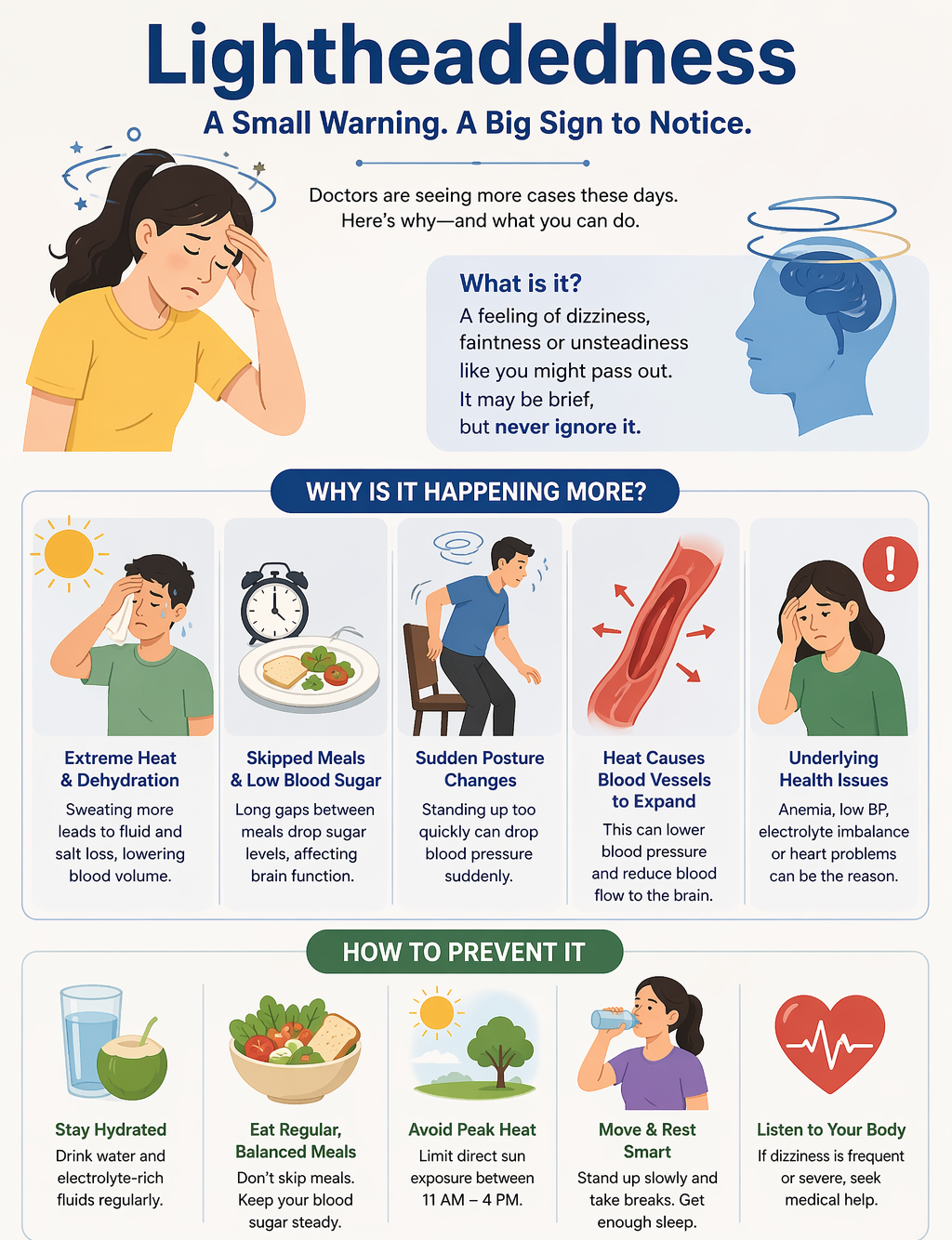
Simple lifestyle changes like staying hydrated, eating regularly, and avoiding heat exposure can prevent it.
Small changes can prevent bigger problems
The reassuring part is that prevention is not complicated. It lies in simple, consistent habits.Start with hydration. Drinking enough water through the day, especially in hot weather, helps maintain blood volume. Adding fluids like buttermilk, coconut water, or lemon water can restore lost salts.Regular meals matter just as much. Eating at fixed intervals keeps blood sugar stable. Long gaps between meals should be avoided.Limiting direct exposure to peak afternoon heat can reduce stress on the body. When moving from sitting to standing, slowing down helps prevent sudden drops in blood pressure.Rest also plays a role. Lack of sleep and constant stress weaken the body’s ability to adapt.Dr Mitra puts it clearly: “Measures to reduce incidence of dizziness include hydration, regular meal consumption, avoiding exposure to the hottest part of the day, and getting adequate rest.”Lightheadedness may feel small, but it is rarely meaningless. The body often sends quiet signals before something serious develops.Medical experts consultedThis article includes expert inputs shared with TOI Health by:Dr Suman Mitra, Internal Medicine Expert – CK Birla Hospitals, CMRI.Inputs were used to explain why doctors are seeing a rise in complaints of lightheadedness, the underlying causes driving this trend, and why timely medical evaluation is important to identify and manage potential health risks.
About the Author


