In a recent Reddit post, a young intern describes his workday that feels less like employment and more like theatre.For the first two weeks, the job was physical and clear. He was outdoors at a pharmaceutical plant, fixing things, moving equipment, walking the site with senior staff. Then, he was moved into an office.Now, he writes, “I sit there for 8 hours and just pretend to be busy.” Most days involve sorting files, opening Excel sheets, and waiting. When managers notice the waiting, they assign what he calls “some unnecessary task that nobody wants to do.” The boredom is heavy enough that he counts minutes. Quitting is tempting, but money makes that impossible.
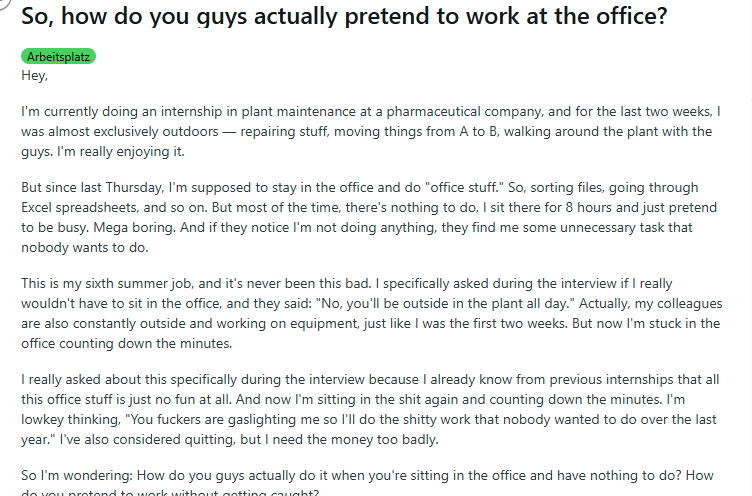
What troubles him most is not the idle time but the act he has to perform. “How do you pretend to work without getting caught?” he asks. He wonders whether to raise the issue with his boss or the agency that technically employs him. Or whether it is better to “just tough it out” for another month.
Looking busy as an unspoken office skill
Scroll a little further on Reddit and there is a visible pattern.
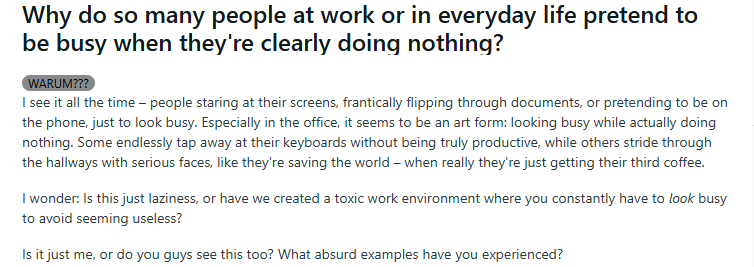
Another employee shares that they observe office corridors full of movement but little output. “People staring at their screens, frantically flipping through documents, or pretending to be on the phone, just to look busy,” they write. Some walk fast with serious expressions, others type loudly, many are just going for coffee. The question they pose is tragicomic. Is this laziness, or is it a workplace culture where looking busy matters more than doing useful work?
The name for the behaviour: Task masking
There is now a term for this behaviour. It is called ‘task masking.’ Task masking refers to the act of appearing productive without producing much that matters. It can look harmless: Unnecessary meetings, documents opened and closed, laptops being carried from room to room. But its spread points to something structural rather than personal.
Even leaders admit to pretending
This is not limited to interns or junior staff. Even senior leaders have admitted to it.In an episode of the WTF podcast, Zerodha founder Nikhil Kamath talked about his own workday. “I’ve realised that most of what I do is pretend to work,” he said. A former CXO once told him that he appeared busy for a fixed number of hours simply because his bosses were around. When Kamath broke it down, he realised that only a fraction of that time was truly productive.
That admission resonates because it feels familiar. Most people cannot produce meaningful output for ten or twelve hours a day. Some days are dense with work, others are not. Yet the expectation remains that effort must look constant.
Why task masking thrives in modern offices
Task masking thrives in that gap. As more offices push employees back under return-to-office mandates, the performance element of work has sharpened. Visibility has become a proxy for value. Sitting at a desk late is read as commitment and leaving early is read as disengagement, regardless of output.This creates a sense of fear. If success is not clearly defined, people optimise for what is safest. They optimise for being ‘seen.’
A management problem, not an employee flaw
Management literature often frames this as an employee problem. Lazy workers, distracted staff, poor discipline. But task masking usually mirrors something else.When people pretend to work, it often means they do not know what good work looks like. Or they know, but do not believe it will be rewarded. Or they sense that outcomes matter less than optics.In such environments, honesty becomes risky. Admitting you are done with your tasks can earn you punishment in the form of pointless work. The Reddit intern understands this instinctively. When he appears idle, he is given work that “nobody wanted to do.” The lesson is clear. Finish early and you pay for it.
The cost of pretending
Over time, this trains people to slow down. To stretch tasks, to replace progress with performance.The cost is not just inefficiency. It is an erosion of trust. Employees learn that effort must be hidden or inflated. Managers lose a real picture of capacity. Work becomes louder but not better.There is also a human toll. Long hours of pretending are draining in a different way than real work. They create anxiety without purpose. You are tired at the end of the day, but unsure why.
When movement replaces meaning
The uncomfortable truth is that task masking is not solved by asking people to work harder. It is solved by asking clearer questions. What does success look like today? What output matters this week. What happens when someone finishes early.Until those answers exist, offices will continue to fill with movement that means very little.And many people will keep doing what the intern describes so plainly. Sitting for eight hours, counting minutes, acting busy, and hoping not to be noticed.
About the Author