
A young boy with a pet crocodile at an Egyptian Nubian village
| Photo Credit: Srinivasa Ramanujam
A crocodile hatchling is crawling on my shirt making its way to my head.
I scream.
Seven-year-old Ali Mustafa nimbly picks up the reptile. He grins, rather mischievously.
We are inside a colourful Nubian village in interior Egypt, located on the West bank of the Nile. To get here, we have to come to Aswan, a city much calmer than the bustling Egyptian capital Cairo. Aswan is a place where you can immerse in history and heritage, much like the rest of Egypt. Apart from exploring popular tourist spots like the Unfinished Obelisk and the Aswan High Dam, , the Nubian village is a must-visit, because of its unique cultural heritage.
You are greeted by a herd of camels gently strolling the streets, even as you disembark from a leisurely boat ride that lets you take in the sights and sounds of the Nile. There is also a line of shops selling Egyptian souvenirs, a common sight in most tourist places. But none of this prepares you for this village’s fascination for crocodiles: in fact, most houses have atleast one crocodile, with children even playing with them!
Ali Mustafa should know. I watch him pick up the hatchling from its habitat, a fish tank perched upon a table in the middle of their home, and tying its mouth carefully. “Do not touch his stomach… he doesn’t really like that,” Ali tells me, as he coaxes me into holding the crocodile.
A few yards away, inside a well, the mother – a crocodile much bigger in size – is watching us.
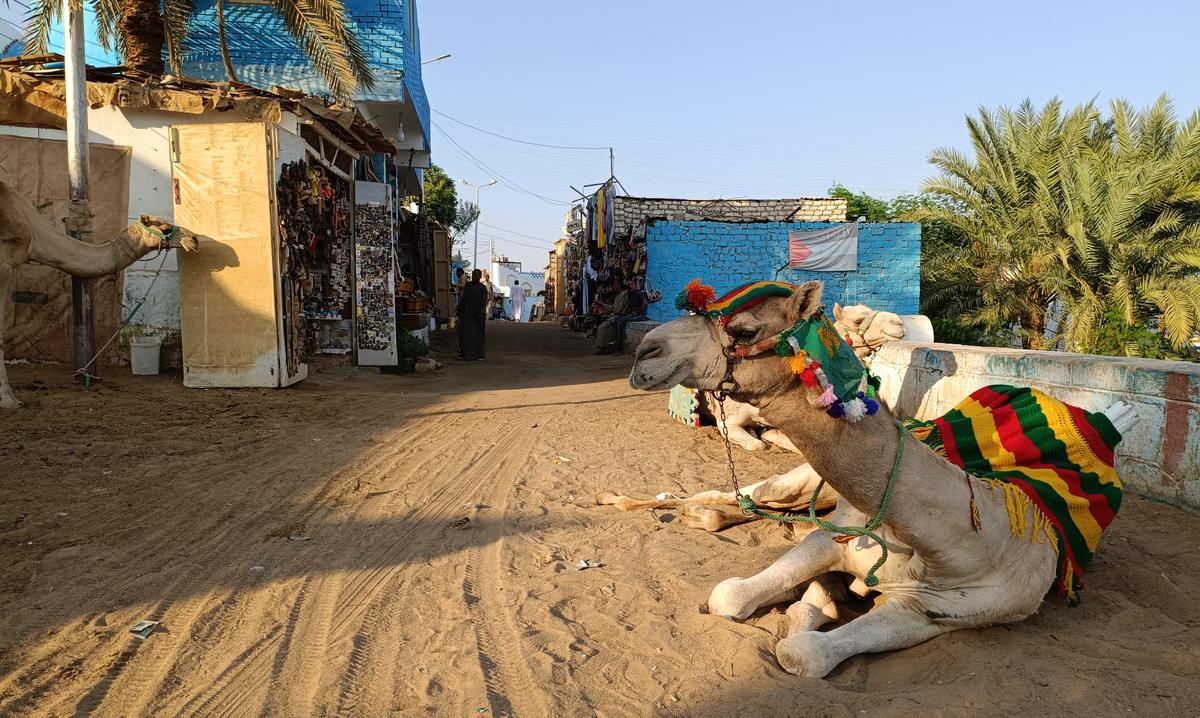
A view of a Nubian village in Egypt
| Photo Credit:
Srinivasa Ramanujam
Reptile god
Ancient Egyptians feared crocodiles, one of the top predators in the Nile, endangering both human lives and livestock. Over time, this fear became awe, so much so that they started worshipping the reptile as Sobek, the ancient Egytpian god depicted as a crocodile. Egypt, in fact, has a dedicated temple for the crocodile (Kom Ombo) and a museum that displays mummified crocodiles and several ancient carvings related to the reptile.
While these are remnants of the past, modern Egypt still pays a hat tip to the crocodile through cultural practices, which are seen even today at places like the Nubian village. Some houses preserve crocodile parts. Others display photos of the reptile on the walls. The reptile is still significant to both tourism and the local belief system, according to Hany Rafail, a tour guide who hails from Aswan. “The locals believe that it wards off the evil eye,” he explains, “They feel that it absorbs jealousy and ensures prosperity for the family and the village.”
L Nhmda seconds that thought. Their family has been living here for generations, and today, along with her husband and three children, these Nubians make ends meet thanks to fishing and tourism. “We have three crocodiles in this house; a mother and her two babies,” she informs, even as she offers us some bread and pickled cheese, “Our ancestors worshipped the crocodile. And, we believe that it is still lucky for us.”
The writer was in Egypt at the invitation of Egyptian Tourism Authority.
Published – December 22, 2025 03:20 pm IST
About the Author


