
It is possible to eat clean, exercise regularly, and still feel tired, bloated, or mentally foggy. That gap often comes down to timing. The human body does not just respond to what is done, but when it is done.Modern routines stretch late into the night and start early in the morning. Meals shift, sleep drifts, and screen exposure fills every gap. Over time, the body clock quietly falls out of sync. This is not dramatic at first, but it builds slowly and shows up in subtle ways.
The hidden clock running your body
Inside the brain sits a tiny control centre that tracks light and darkness. It guides sleep, hunger, hormone release, and even body temperature. This internal timing system is known as the circadian rhythm.A report by the National Institute of General Medical Sciences (NIH) explains how this clock runs on a roughly 24-hour cycle and responds strongly to light exposure.When this rhythm is steady, the body knows when to feel alert and when to wind down. But when it gets pushed around by irregular schedules, the signals start to blur. Sleep may come late. Hunger may spike at odd hours. Energy dips become unpredictable.
How modern life quietly disrupts timing
The disruption rarely feels serious in the moment. It begins with small shifts.Late-night scrolling delays sleep by an hour. Weekend sleep-ins stretch the body clock. Meals happen whenever there is time, not when the body expects them.Artificial light plays a big role. According to the Centers for Disease Control and Prevention (CDC), exposure to light at night can suppress melatonin, the hormone that signals sleep.This creates a mismatch. The brain stays alert while the body tries to rest. Over weeks and months, this pattern turns into chronic misalignment.

When sleep, meals, and daily routines become irregular, this clock falls out of sync. This misalignment affects energy, metabolism, and long-term health.
When timing goes wrong, the body feels it
The effects are not limited to poor sleep. They spread across systems.“As a sleep specialist, I often observe that people are so focused on the quality of sleep, or the duration of sleep, that they are not paying sufficient attention to the timing of sleep, which is also very important. The human body, as I mentioned, follows a circadian rhythm, a natural 24-hour internal clock that regulates our sleep and wake cycles, hormone secretion, metabolism, and even body temperature. When this natural rhythm gets disrupted because of irregular sleep patterns, exposure to screens in the middle of the night, or irregular habits, this leads to what we call a state of circadian misalignment.This not only affects the quality of sleep but also affects our lives in a number of ways. It can lead to daytime fatigue, difficulty in concentration, and even increase the risk of metabolic problems like diabetes and cardiovascular diseases. So, timing, in a way, is as important as the habits that are being followed,” said Dr Nikhil Modi, Senior Consultant, Respiratory, Critical Care and Sleep Medicine, Indraprastha Apollo HospitalsResearch from the National Heart, Lung, and Blood Institute (NIH) supports this link between circadian disruption and higher risks of metabolic and heart conditions.The body is not just tired. It is confused.
Food, sleep, and hormones: all on a schedule
Every system in the body follows timing cues. Hormones rise and fall through the day. Digestion works best at certain hours. Even insulin sensitivity changes depending on the time.Studies from the National Institutes of Health (NIH) show that eating late at night can disrupt metabolism and increase fat storage.This explains why the same meal can affect the body differently depending on when it is eaten. A late dinner is not just extra calories. It is a signal that confuses the body’s rhythm.
Why fixing habits is not enough
Many people improve diet and add workouts but still see little change. The missing piece is often consistency in timing.Sleeping at different hours each day, skipping meals, or exercising randomly keeps the body guessing. It never settles into a stable rhythm.The question is simple: can the body perform well if it does not know what to expect? The answer is no. It needs predictability as much as it needs nutrition and movement.
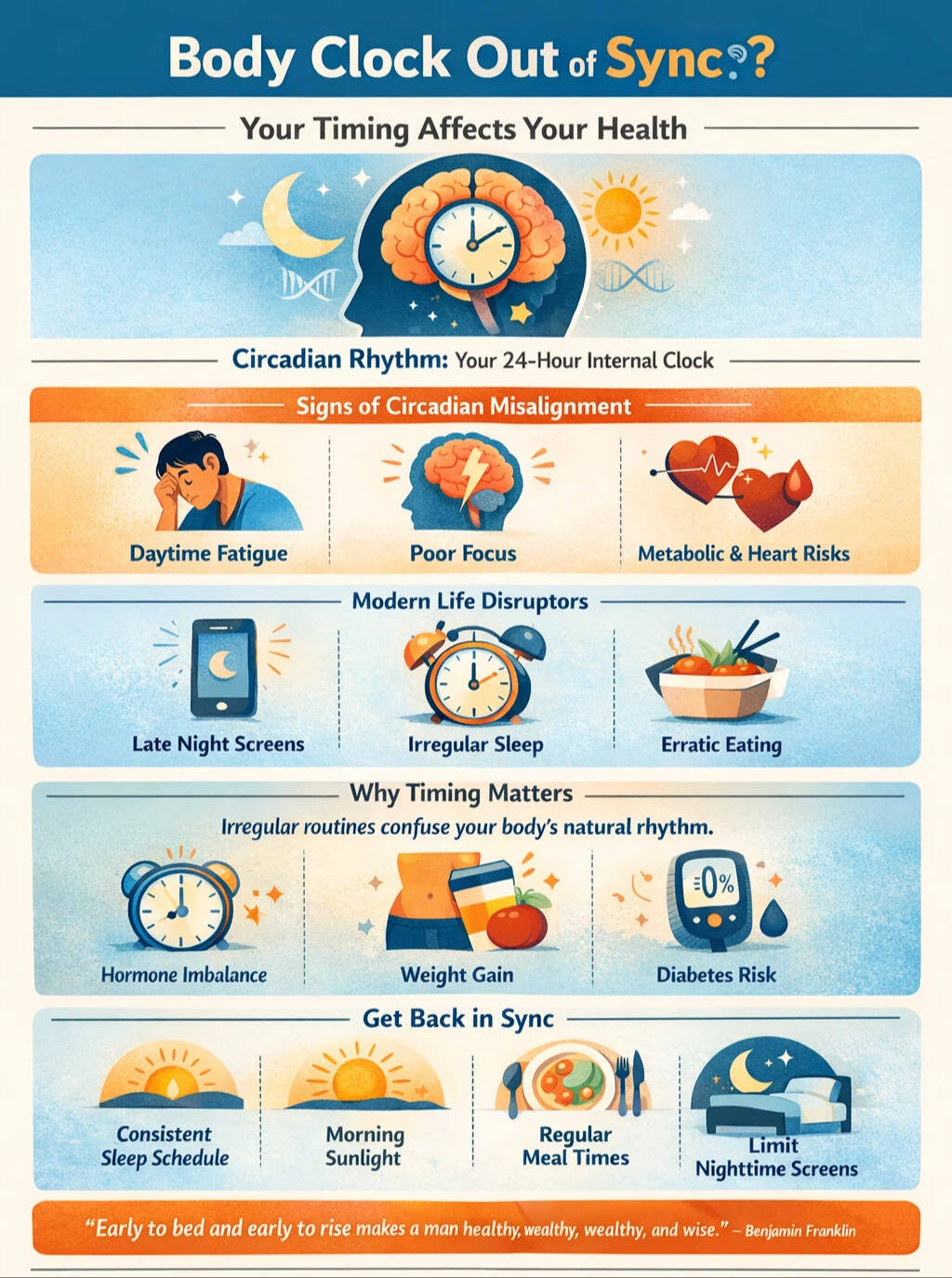
Restoring consistent timing can help the body function more efficiently and feel balanced again.
Bringing your body clock back in sync
Realignment does not require extreme changes. It begins with small, steady shifts.
- Sleep and wake at the same time daily, even on weekends.
- Get natural sunlight within the first hour of waking.
- Avoid bright screens at least one hour before bed.
- Eat meals at consistent times, especially dinner.
- Limit late-night snacking and caffeine after evening hours.
These changes may feel basic, but they rebuild the body’s sense of time. Within weeks, energy improves, sleep deepens, and focus sharpens.Medical experts consultedThis article includes expert inputs shared with TOI Health by:Dr Nikhil Modi, Senior Consultant, Respiratory, Critical Care and Sleep Medicine, Indraprastha Apollo Hospitals.Inputs were used to explain how a misaligned body clock can impact overall health, why timing plays a crucial role beyond daily habits, and why aligning routines with your natural rhythm is essential for better well-being.
About the Author


