
A nap sounds simple. Close your eyes. Drift off. Wake up better.But that is not always how it plays out.Some naps leave a strange heaviness behind. The body wakes up, but the mind lags. There is fog, irritation, and a quiet sense that something feels off. It raises a simple question: why does rest sometimes feel like the opposite?The answer lies deep inside the brain’s timing system. It is less about sleep itself and more about when and how the brain enters it.
The moment a nap goes too deep
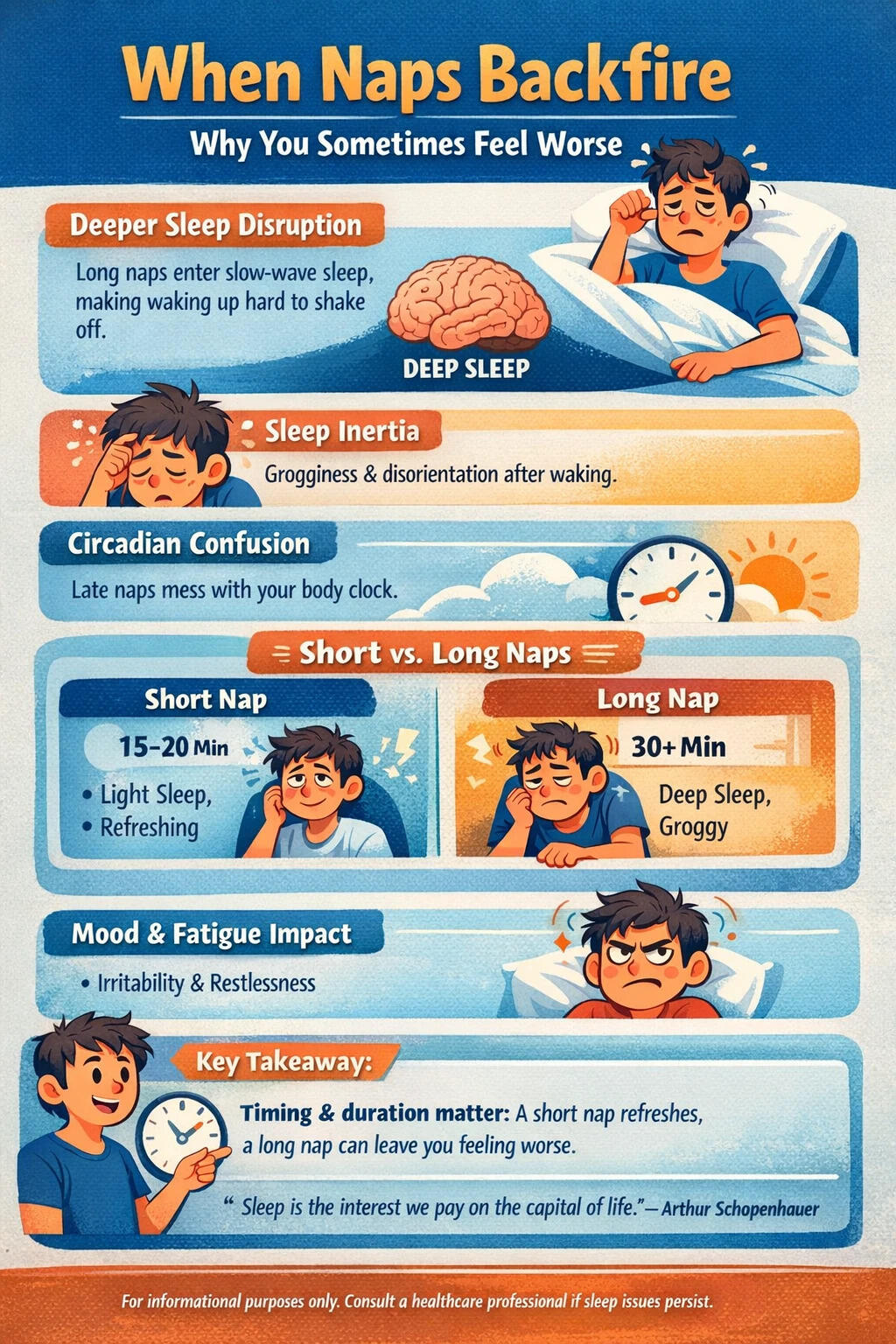
Sleep is not one steady state. It moves in stages. Light sleep comes first. Then deeper layers follow.A short nap usually stays in lighter stages. That is where the brain resets gently.But stretch it beyond 20-30 minutes, and the brain slips into slow-wave sleep. This is deep, heavy sleep. It is the same phase that repairs the body at night.Waking up from this stage is not smooth. It feels abrupt. Like being pulled out of something unfinished.That is often when the nap turns against you.
The fog has a name: sleep inertia
There is a reason that groggy feeling feels so real. It is called sleep inertia.It is not just “feeling lazy.” It is a biological state. The brain’s alertness systems are still muted. Blood flow to key areas, like the prefrontal cortex, is reduced for a short time after waking.A report from the US Centers for Disease Control and Prevention (CDC) explains how insufficient or poorly timed sleep can impair alertness and reaction time.That same mechanism explains why waking mid-cycle feels so disorienting. The body is awake, but the brain has not caught up yet.

Short naps refresh the brain. Longer ones push it into deep sleep, leading to grogginess known as sleep inertia. Poor timing can also disrupt the body’s internal clock.
Your internal clock is not flexible
The body runs on a circadian rhythm. It follows light, darkness, and routine.Daytime is for alertness. Night is for deep recovery.A long nap, especially in the late afternoon, confuses this rhythm. It sends mixed signals.The National Institute of Neurological Disorders and Stroke (NINDS) notes that the sleep-wake cycle is tightly regulated and easily disrupted by irregular sleep patterns.So, when a nap stretches too long or happens too late, it does not just affect that moment. It spills into the evening. Night sleep becomes lighter or delayed. The next day starts already off balance.
The brain doesn’t like interruptions
Sleep works best when it completes a cycle. A full cycle takes about 90 minutes.Interrupting it midway creates a kind of internal friction.Dr Keni Ravish Rajiv explains it clearly, “Many people assume a nap is always restorative, but the brain doesn’t always cooperate that neatly. If you wake up feeling worse, it’s often because you’ve entered deeper stages of sleep—what we call slow-wave sleep—and then been pulled out abruptly. This creates ‘sleep inertia,’ a state where the brain’s alertness centres are still offline while the body is awake. You feel groggy, disoriented, even irritable.There’s also a circadian component. Our body clock is programmed to allow us to be awake during the day and to sleep at night. A long or poorly timed nap, particularly in the late afternoon, can upset this balance, which can leave both the nap and subsequent night’s sleep unrefreshing.Neurologically, it is a conflict between what stage of the sleep cycle your brain is in and what stage of the day your body needs to be in. Short naps of about 15–20 minutes typically keep you in lighter sleep stages and can enhance memory, mood, and focus. But once you cross that threshold, the brain dives deeper, and waking up becomes more like being pulled out of anesthesia than rest.So, it’s not that naps are bad—it’s that timing and duration determine whether your brain thanks you or protests.”The key idea is simple. The brain dislikes being interrupted mid-process.
Why short naps feel different
A 15-20 minute nap often feels refreshing. There is clarity after waking. Even mood improves.That is because the brain stays in lighter sleep stages. No deep dive. No abrupt exit.A study supported by NASA on pilot fatigue found that short naps improved alertness and performance significantly.The difference is not just duration. It is the stage of sleep reached within that time.
A bad nap is often a signal that the sleep cycle has been interrupted or misaligned.
The emotional side of a bad nap
A heavy nap does more than slow the brain. It can affect mood.Irritability after waking is common. So is a strange sense of restlessness.Part of this comes from the brain’s incomplete transition back to wakefulness. But part of it is also psychological. The expectation of feeling better is broken.It sounds poetic, but it hints at something real. Sleep is not optional. It is structured. And when that structure is disturbed, the effects are felt immediately.
What your nap is trying to tell you
A nap that leaves you worse off is not random. It is feedback.It may point to poor night sleep. Or irregular timing. Or even accumulated fatigue that cannot be fixed in 30 minutes.The body is asking for a more stable rhythm, not a quick fix.So, the next time a nap feels heavy, it is worth asking: was it too long, too late, or too deep? The answer often sits in one of these.Medical experts consultedThis article includes expert inputs shared with TOI Health by:Dr Keni Ravish Rajiv, Senior Consultant – Neurology and Head of Epilepsy Service, Aster Whitefield Hospital.Inputs were used to explain why short naps can sometimes leave you feeling groggy instead of refreshed, and why understanding what’s happening in your brain can help you nap more effectively.
About the Author


